

We tend to think of a floor plan as just a picture showing… a floor plan. What could possibly be added to it? What kind of interactivity?
It’s actually quite simple. An Interactive Floor Plan also shows the exact positions where the camera was placed during the MLS photo shoot. Each position is clickable, opening the respective listing photo:
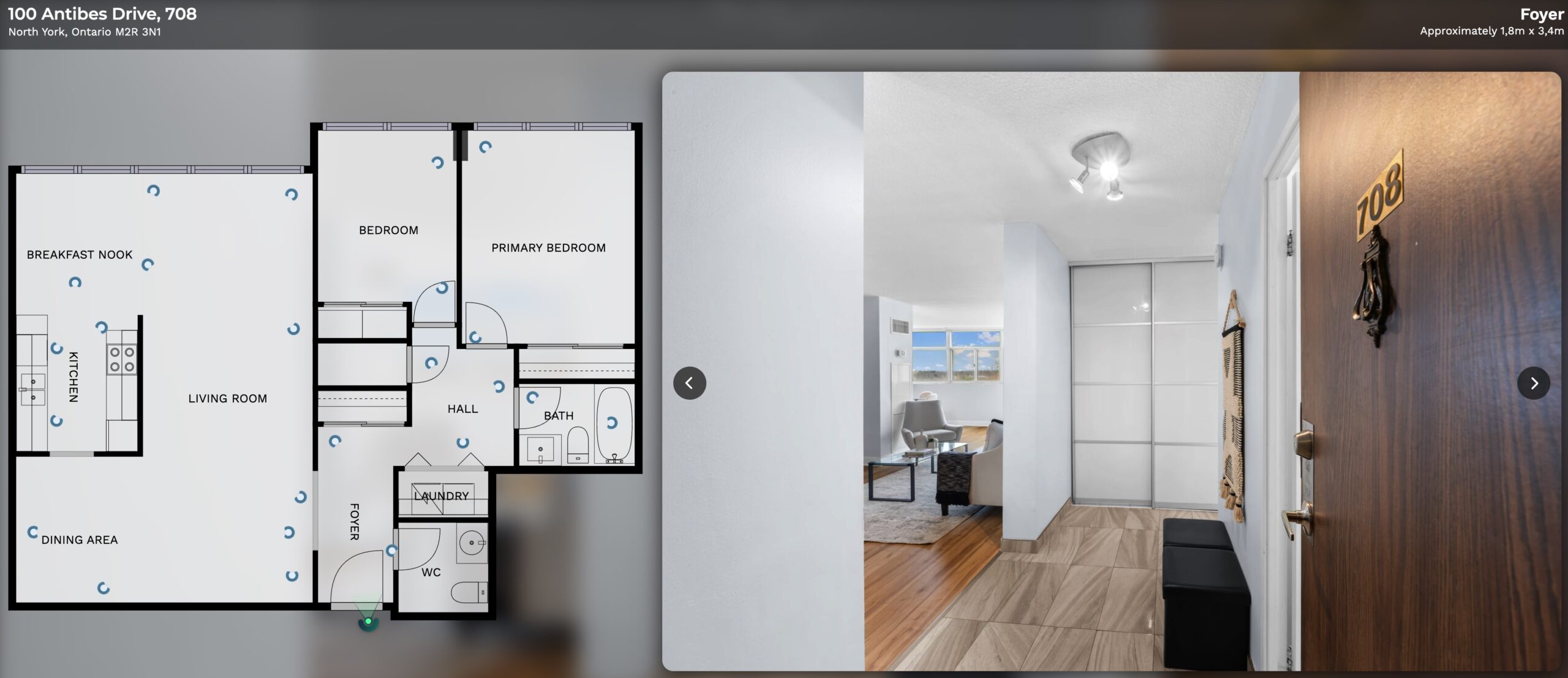
When you order an Interactive Floor Plan, you’ll receive not only a shareable link you can add to your listing or use in marketing materials — the Interactive Floor Plan is fully mobile-friendly — but also a good old-fashioned floor plan with measurements as a standard image file.
In fact, the Interactive Floor Plan is less of a floor plan and more of an original way to browse a photo gallery. More precisely, it’s a combination of these two forms of real estate media which gives a potential buyer a clear understanding of the space — and creates an experience somewhat reminiscent of a 3D Virtual Tour.
When the viewer is simply browsing photos or watching a video, it’s hard for them to visualize the “full picture”. With this, they get complete visual clarity.
What’s more, an Interactive Floor Plan feels like a fun, engaging game, where you connect the plan with the photos to form a mental image. See for yourself by checking out this example.
A budget-friendly alternative to a 3D virtual tour? Absolutely.
We could say that the Interactive Floor Plan is “almost” a 3D Virtual Tour — in the same sense that our Premium Cinematic Slideshow (video made of still images) is “almost” a video. Of course, that’s said with a wink — but every joke has a grain of truth. In fact, the Interactive Floor Plan even has some advantages:
- With an Interactive Floor Plan, you always have a “map” in front of you that shows where you are inside the house and which direction you’re looking. You understand room layout and visualize how spaces connect. In a 3D Visual Tour, however, it’s still hard for the viewer to grasp the “full picture”. Jumping from place to place and rotating the view with a mouse are cool, but at any given moment you still see only a very limited portion of the overall space, just like when looking at a regular photo.
- The MLS photos used in the Interactive Floor Plan are taken by a professional photographer from carefully chosen angles, deliberately composed to make the best possible impression on a potential buyer. A 3D Visual Tour’s 360° camera, on the other hand, is placed in the middle of the room and simply captures everything around it — with no artistic vision, no compositional intent, and no use of the laws of perspective.
- In MLS photos, verticals are always perfectly straight (of course, unless the curvature of space is an artistic design). At the same time, 360° cameras use “fish eye” lenses that curve any image, resulting in extreme barrel distortion. It’s taken for granted, but in reality, it’s an unavoidable drawback of this type of photography.
- The image quality is incomparably higher in the Interactive Floor Plan. Most budget 3D Virtual Tours use photos straight from a 360° camera with primitive lenses – typically video bloggers use these cameras with an “invisible stick” outdoors, but shooting indoors is far more challenging. There are also expensive cameras for 3D virtual tours. You will like the quality of their photos more than their price. But, regardless the camera level, the biggest problem is that photos of a 3D Virtual Tour don’t go through the high-end editing process applied to MLS photos.
As we see, a 3D Virtual Tour is “almost” an Interactive Floor Plan in many aspects. In fact, these are simply different products, each with its own pros and cons. Neither one is inherently better or worse in general.
The chances that a true 3D Virtual Tour would lead to a deal when an Interactive Floor Plan wouldn’t are vanishingly small — and the savings are always obvious.
As I said, Interactive Floor Plan always comes with a regular Floor Plan. If you were planning to order a regular Floor Plan anyway, the upgrade to Interactive is just a few bucks. And if you were not planning to order a regular Floor Plan, you’ll get it “as a gift” if you order the Interactive Floor Plan, since you specifically want it.
I’m not saying that the Interactive Floor Plan is just as good as a 3D Virtual Tour if a 3D Virtual Tour is specifically what you’re after. Prices are flat-rate for any square footage.Please note that we don’t offer drone and 3D virtual tour.
Instead of 3D virtual tour, we offer an Interactive Floor Plan.
Prices are flat-rate for any square footage.
Instead of 3D virtual tour, we offer its budget-friendly alternative – Interactive Floor Plan.